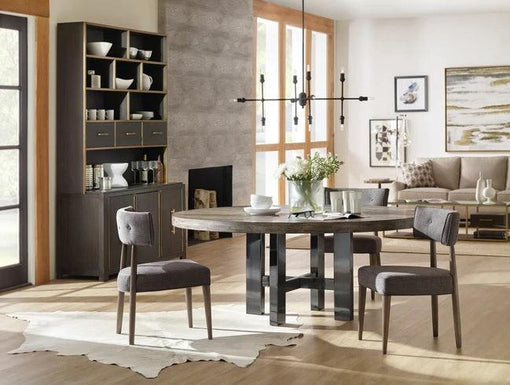
The dining room is probably one of the most crucial rooms in a house to decorate. It is nothing but a general and straightforward design process with a few pieces of dining furniture needed. By getting the right style and size of furniture for your dining space you can give the whole area a totally new look with no extra effort. So, if you want to make sure that you, your family members, and your visitors experience comfort and beauty in your dining area then you are at the right piece of information. We have got a guide for you about how to style your dining room with the available ranges and styles of dining furniture.Hooker Furniture Curata Round Dining Table
Dining Tables
Dining tables form an integral part of the dining furniture. One must keep in mind the size of the dining room and the number of persons to be seated while buying a dining table. Dining tables come in various sizes, styles, and patterns and can be chosen and bought according to the requirement. The various kinds of dining tables include buffets, tabletop decor and hutches, rectangular tables, tables with glass tops, round tables, and even more.Hooker Furniture La Grange 60in Friendship Table
Dining Chairs and Benches
Dining tables are incomplete without the right size of chairs for people to be seated for the meals. The dining chairs must always be chosen according to the height, size, and type of table so as to offer a plush dining experience. Dining benches are also a good seating option for the dining area.Lexington Ariana Bellamy Upholstered Side Chair Customizable Custom
Storage Cabinets
Apart from dining tables and chairs, storage cabinets also come under the category of dining furniture. Storage cabinets are meant to store cutlery, crockery ware, and other items of use depending upon your choice and requirement. Storage cabinets make the dining area look detailed and complete and accentuate the space in several aspects.Hooker Furniture Affinity Server
Dining Room Decor
There is no doubt in the fact that a major portion of the dining area relies on the dining room furniture but it is also true that opting for a minimal wall and accessory decor can only make the space look even more appealing and nice. Going for large art for your walls and lighting fixtures can always be a good decor idea for the dining space.John Richard Sale Gold Leaf Branches Branches I
Summary
Find sofas, tables, and other furniture accessories that make your living space décor complete with the flair of style and elegance. You can choose from a range of accessories, including area rugs, dressers, tables, stools, and much more. For more furniture accessories, including tabletop, rugs as well as lighting solutions, visit our website. We, at Grayson Living, cater to all your requests, from fabric samples, catalog shipments, and CAD designs, to inspirational boards. Our designers are always ready to accommodate any requests virtually.
The dining room is probably one of the most crucial rooms in a house to decorate. It is nothing but a general and straightforward design process with a few pieces of dining furniture needed. By getting the right style and size of furniture for your dining space you can give the whole area a totally new look with no extra effort. So, if you want to make sure that you, your family members, and your visitors experience comfort and beauty in your dining area then you are at the right piece of information. We have got a guide for you about how to style your dining room with the available ranges and styles of dining furniture.Hooker Furniture Curata Round Dining Table
Dining Tables
Dining tables form an integral part of the dining furniture. One must keep in mind the size of the dining room and the number of persons to be seated while buying a dining table. Dining tables come in various sizes, styles, and patterns and can be chosen and bought according to the requirement. The various kinds of dining tables include buffets, tabletop decor and hutches, rectangular tables, tables with glass tops, round tables, and even more.Hooker Furniture La Grange 60in Friendship Table
Dining Chairs and Benches
Dining tables are incomplete without the right size of chairs for people to be seated for the meals. The dining chairs must always be chosen according to the height, size, and type of table so as to offer a plush dining experience. Dining benches are also a good seating option for the dining area.Lexington Ariana Bellamy Upholstered Side Chair Customizable Custom
Storage Cabinets
Apart from dining tables and chairs, storage cabinets also come under the category of dining furniture. Storage cabinets are meant to store cutlery, crockery ware, and other items of use depending upon your choice and requirement. Storage cabinets make the dining area look detailed and complete and accentuate the space in several aspects.Hooker Furniture Affinity Server
Dining Room Decor
There is no doubt in the fact that a major portion of the dining area relies on the dining room furniture but it is also true that opting for a minimal wall and accessory decor can only make the space look even more appealing and nice. Going for large art for your walls and lighting fixtures can always be a good decor idea for the dining space.John Richard Sale Gold Leaf Branches Branches I
Summary
Find sofas, tables, and other furniture accessories that make your living space décor complete with the flair of style and elegance. You can choose from a range of accessories, including area rugs, dressers, tables, stools, and much more. For more furniture accessories, including tabletop, rugs as well as lighting solutions, visit our website. We, at Grayson Living, cater to all your requests, from fabric samples, catalog shipments, and CAD designs, to inspirational boards. Our designers are always ready to accommodate any requests virtually.
A small living area doesn't have to feel cramped — with the right design approach, it can feel just as grand and luxurious as any spacious home. In this guide, we cover four key strategies: starting with a smart floor plan layout, using color psychology to visually expand the space, and selecting sleek multi-functional furniture like low-profile sofas, transparent coffee tables, nesting ottomans, and open-frame accent chairs. Whether you prefer light, airy tones or a dramatic dark palette, these expert tips will help you maximize every square inch in style.
People shop for a chair. Then they shop for a desk. Two separate purchases, two separate return windows, and often no one checks whether the two actually work together once they're in the same room. That's how a home office ends up with a great chair that doesn't quite fit the desk or a desk that leaves you sitting at an awkward height.
The height, seat depth, armrests, legroom, and desk surface all need to work together. Get one of those measurements wrong and you'll notice it pretty quickly, usually after you've spent a few hours working.
Why the chair and desk have to match each other?
Elbows are the starting point. When you're seated with your feet flat and your shoulders relaxed, your elbows should sit somewhere around 90 to 110 degrees, resting close to your sides. If the desk sits too high, your shoulders creep up toward your ears, and if it’s too low, you will be hunching forward to reach the keyboard. Neither one causes any pain right away. It builds over weeks and months, which is exactly why so many people blame the chair when the actual issue is a two-inch mismatch with the desk.
Most desks sit around 28 to 30 inches high, but that doesn't make the height right for everyone. Your own height, chair adjustments, and how you work all come into play. That's why learning how to buy office chairs alongside the right desk matters. The two pieces need to suit your proportions when you're actually sitting and working, not just look right next to each other.
What actually matters in an office chair?
Seat height adjustability comes first, and it needs real range, not just an inch or two. A chair that adjusts from roughly 16 to 21 inches covers most people and most desk heights without forcing a compromise.
Lumbar support is really important. A chair without it feels fine for the first hour and rough by the third. So, look for support that either adjusts up and down or curves naturally into the lower back without needing to be propped with a separate cushion.
Seat depth is another easy detail to overlook. There should be a gap of two or three fingers between the back of your knees and the edge of the seat. If it’s too deep, the edge will cut into the back of your legs, and if it’s too shallow, then there's nothing supporting your thighs.
Armrests should adjust, ideally in height and width both. Fixed armrests that don't match your desk height end up doing more harm than good, since they either force your shoulders up or sit too low to use at all.
What actually matters in a writing desk?
Desk height is the obvious one, already covered above. Depth matters just as much, though. A desk under 24 inches deep starts to feel cramped the moment a monitor, a keyboard, and a notebook all need to share the surface. A depth of somewhere around 28 to 30 inches gives enough room to actually spread out.
Legroom underneath gets overlooked constantly. A desk with drawers or a solid center panel can look great in photos and still leave almost no space for your knees once a chair with armrests is pulled in. Always check the clearance underneath before anything else.
Some people find real value in a desk that adjusts, sit-stand or otherwise, especially if the room doubles as a workspace for more than one person. Not a requirement, but worth considering if the desk needs to flex.
Putting the two together
This is really what an office chair and desk buying guide should focus on, yet it's also the part people skip most often. Sit in the chair you're considering at the height you'd actually use it, next to the desk you're considering at its actual height. If that's not possible in person, at least map the numbers against each other before buying. A chair that maxes out at 20 inches paired with a desk that sits at 31 inches is going to leave shoulders working overtime no matter how good either piece is on its own.
Grayson Living's office chair collection is built with that kind of range in mind, and pairing the right chair with the right desk height is really the heart of any solid office chair and desk guide, more than any single spec on either piece alone.
A workspace that fits right gets used more. Simple as that. The right setup doesn't need willpower to sit down to. It just works, day after day, without anyone thinking twice about it.
Not sure which chair and desk combination fits your space? Reach out to Grayson Living, and their team can help you land on a pairing that actually works for how you use the room, not just how it photographs.
FAQs
What's the ideal desk height for most people?
Around 28 to 30 inches, though it depends on your own height and how your chair adjusts.
How do I know if an office chair fits me properly?
Feet flat, elbows near 90 to 110 degrees, and a small gap between the seat edge and the back of your knees.
Do I need a sit-stand desk?
Not necessarily. It helps if you spend long hours at the desk, but a well-matched fixed-height setup works fine for most routines.
Should I buy the chair or the desk first?
Neither, ideally. Check both sets of measurements together before buying either one on its own.
Four to six inches. That's the whole gap between a table that fits your kitchen and one that simply doesn't. On a tape measure, four to six inches barely even registers. But sit at the wrong one for twenty minutes, though, and you'll know exactly what those inches are doing: knees jammed against the underside of the top, or feet swinging with nothing underneath to rest on. Neither is comfortable, and neither gets better with time.
This is really what the whole bar height table vs counter height table question comes down to. Two heights, and depending on which one you land on, a room ends up getting used in fairly different ways. Most people never think it through ahead of time. They notice something's off after the table's already delivered, the chairs are already tucked in wrong, and returning a dining set isn't exactly a quick fix.
The numbers first
Counter height lands around 34 to 36 inches, give or take, depending on the manufacturer. That’s not a random number; it's built to line up with a standard kitchen counter, so cooking and eating can happen at roughly the same working level without anyone hunching or reaching up. Bar height sits noticeably taller, usually 40 to 42 inches, closer to what you'd actually lean against at a real bar counter.
The seating has to match. Counter-height tables pair with stools that are generally 24 to 26 inches high, while bar-height tables need 28 to 30-inch stools. Mix the two, and the proportions immediately feel off. Even if you can't put your finger on why, the table is less comfortable to sit at because the seat-to-table height simply isn't right.
Why the difference between bar height and counter height actually shows up?
The difference between a bar-height table and a counter-height table becomes much clearer once the table is in everyday use. Counter-height tables feel more relaxed and familiar because they're close to the height of a standard kitchen counter; they're well suited to everyday meals, helping with homework, working on a laptop, or sitting over a long conversation without thinking much about the furniture itself.
Bar-height tables create a different atmosphere. People are seated higher, conversations feel a little more casual, and it's common for someone to stand and lean against the table while talking. That's one reason bar-height tables are so popular in home bars, entertainment areas, and game rooms, while counter-height tables are more commonly found in kitchens and dining spaces.
Many homes have room for both. A counter-height table can handle everyday dining, while a bar-height table by a window, in a breakfast nook, or beside a home bar creates a separate spot for drinks or casual gatherings. It doesn't have to be one or the other. It depends on how you use the space.
Counter height vs. bar height table: Which one fits your home?
The choice between a counter vs. bar-height table usually comes down to how the space is used. For families with young children, counter-height tables are the more practical option. The lower seating is easier to get in and out of, which ultimately makes everyday meals a little more comfortable for everyone.
Bar-height tables suit a different way of living. They're a popular choice for smaller households, homes that entertain regularly, or spaces where people naturally gather for drinks and conversation rather than long, formal meals. Their taller profile also gives them a lighter visual footprint in some open-plan layouts, especially when paired with slim stools.
None of this is a hard rule, though. Plenty of families do bar height fine. Plenty of couples with no kids still want counter height because it just feels more like a real dinner table. Depends on the house.
Making the final decision
Once the height question gets settled, the rest of the decision is honestly the more fun part. Wood finish, metal legs, and a stone top instead of a wood one; there's plenty of room to bring in personality once the practical stuff is out of the way. Grayson Living carries both bar-height and counter-height tables, and they're built to hold up to daily use rather than just look good for a few dinner parties before wearing out.
A table isn't just a surface to set plates on. It ends up shaping how a room actually gets lived in—who gathers where, how long people stick around, what the space feels like on a random Tuesday, and not just when it's set for company.
Not sure which height actually fits your space? Grayson Living's team can walk you through it and help you land on a table that works for the room you have and the way you actually use it, not just the way it looks in a catalog.
FAQs
Is bar height or counter height better for a small apartment?
Bar height usually works better. It takes up less visual space and pairs well with slim stools.
Can bar stools work with a counter-height table?
Not comfortably. Stick with stools built for counter height, around 24 to 26 inches tall.
Which height is more common on outdoor patios?
Bar height, especially near a grill or outdoor kitchen setup.
Do counter-height tables suit formal dining?
Yes. They sit close enough to standard dining height for everyday meals and more formal ones alike.
Somewhere along the way, every low-upholstered object started being pushed in front of a sofa and given the same job: put your feet on it.
A pouf can do a lot better than that.
Part of its charm is how low it sits. It stays below sofa arms, chair backs, and tabletops, so you can add one without suddenly making the room feel crowded. A round pouf can soften a room full of sharp corners. Put two beside a console and they start to look almost sculptural.
So, how do you use a pouf without automatically parking it in front of the sofa? These seven ideas are a good place to start.
How to use a poufs?
1. Break up a room that has gone too square
Rectangular sofa. Rectangular rug. Square coffee table. Two boxy side tables.
All beautiful pieces on their own, perhaps. But when you put them in the same room, everything looks like it was laid out with a ruler.
A round pouf can loosen things up. Place one slightly off the rug or beside an angular chair, where the curve has room to stand out against all those straight edges.
The pouf doesn't need a loud print or bright color. Shape alone can be enough, especially in contemporary rooms ruled by clean lines.
2. Put two where everyone expects a bench
The foot of the bed usually gets the same treatment: bed, rug, bench. It looks good, sure, but you've seen it before.
Try two poufs instead.
Leave a little space between them rather than pushing them together. This way you can still see the shape of each pouf, and the arrangement feels intentional without looking too staged. A matching pair keeps things neat, while two related designs can make the bedroom feel a little more relaxed.
This is one of those floor pouf ideas that works particularly well in a larger bedroom, where a single small pouf could easily disappear. Two fill the space without putting one long, heavy piece of furniture across the foot of the bed.
3. Finish the back of a floating sofa
A floating sofa has an awkward side nobody talks about: the back. When it faces the rest of an open room, the usual fix is a long console table pushed behind it.
Two poufs can be far more interesting. They keep the sightline open and, unlike a console, can be put elsewhere when extra seating is needed. One might end up near the coffee table; the other could disappear into a bedroom for a week.
Just don't tuck them underneath the sofa as though you're trying to hide them. Pull them back a little. They should look like part of the room, not two things waiting to be put away.
4. Give a console table something below eye level
Console styling has a familiar recipe: a lamp, books, a bowl, and framed art. Then the space underneath stays empty or receives two baskets.
Poufs can be far more interesting.
Tuck one or two beneath a long console, provided the dimensions allow comfortable clearance. The arrangement gains detail near the floor and gives the pouf a home when it isn't elsewhere in use.
A pale pouf can sharpen the contrast beneath dark wood; deeper upholstery may sit better under a light console.
Not every piece of furniture needs decorating from the waist up.
5. Pull a large conversation area inward
Large living rooms sometimes develop a furniture border. Sofa on one side. Chairs near another. Acres of rug in between.
Low seating can change the spacing.
For pouf seating living room arrangements, place two poufs closer to the coffee table instead of lining them against a wall. They bring the furniture inward and make a broad seating area feel more connected. Their lower height also keeps sightlines open.
A pair can face the sofa or occupy the open end of an L-shaped arrangement. Check the intended use before treating any pouf as seating.
The placement should look purposeful even when nobody is sitting there. That is the real test.
6. Let one live beside a freestanding tub
Bedrooms and living rooms don't own poufs.
In a spacious bathroom, a pouf can bring softness to a room dominated by stone, tile, glass, and metal. Place one near a freestanding tub or vanity where there is dry, open floor space and the product's materials suit the environment.
Keep it clear of regular splashes and damp areas. This belongs in a spacious bathroom, not wedged beside the shower.
Unexpected floor pouf ideas work best when the room can genuinely support them.
7. Treat a beautiful pouf like a low sculpture
Some poufs have enough shape, texture, or pattern to stand on their own. They don't need to be tucked beneath anything.
Place one near large artwork or between a lounge chair and a window. There is no need to invent a function every minute of the day.
A pouf can contribute through proportion, material, and form at floor level, an area often handed over entirely to rugs and furniture legs.
At Grayson Living, poufs can be considered alongside luxury furniture and home decor, rather than treated as a late addition.
The pouf doesn't need a permanent address
The more interesting answer to how to use a pouf may be to stop assigning it one fixed location.
Try it behind the sofa. Move it beneath the console. Separate a pair from the foot of the bed. Its scale allows the occasional shift.
Look at shape, height, texture, and color. Notice where furniture lines repeat or everything happens at the same level. A pouf may belong there.
Explore luxury furniture and home decor at Grayson Living to find pieces for refined, carefully furnished interiors. Contact Grayson Living for help choosing furnishings and accents that bring a more individual point of view to your home.
Frequently Asked Questions
Where can a pouf be placed besides the living room?
A pouf can suit bedrooms, spacious bathrooms, entryways, or wide hallways when its materials and placement fit the space.
Can poufs be used as living room seating?
Some poufs suit casual seating, but always check the product's intended use and construction.
Should a pouf match the sofa?
No; it can connect through color, texture, shape, or another finish already present in the room.
Are round poufs good for modern interiors?
Yes, round poufs can soften rooms dominated by straight furniture lines and angular shapes.
Can two poufs be styled together?
Yes, a related pair can work beside a console, near a coffee table, or at the foot of a bed.
Five pillows. All beige. All the same size. Perfectly spaced across an expensive sofa.
Nothing is technically wrong, but still, this arrangement makes a living room feel strangely stiff, as though nobody is expected to sit down until the photograph has been taken. Decorative pillows work better when there is a little difference between them. A larger pattern beside a solid one, linen near velvet, or one pillow that seems slightly unexpected but picks up a color from the rug across the room.
That is where how to arrange throw pillows becomes less about following a set formula. The sofa, the room, and even the way the seating is actually used should have some say in it. A formal living room in a Manhattan apartment won't necessarily need the same pillow mix as a wide sectional in a California family home. The arrangement has to belong to the furniture first.
Read the room before buying another pillow
Look at what is already there in the room. Not in a serious, clipboard-in-hand way. Just notice the colors that keep appearing again and again. Perhaps there is a dull green in the rug, brass on the lighting, and warm, walnut furniture. Those details offer a better starting point than choosing six pillows because they looked attractive together on a product page.
Of course, the pillows should complement the sofa, but color is only one part of the picture. Curtains, artwork, an accent chair, and even a nearby bookcase can influence the mix. A blue pillow may feel random on a cream sofa until the same blue appears in a painting across the room. Then suddenly, it makes sense.
Matching Colors Exactly Can Make Things Feel Flat
Take brown, for example. Chocolate, camel, tobacco, sand, and warm taupe can all sit in the same room without being identical; those slight differences keep the sofa from looking like it came pre-packaged as a set. Blue works the same way; navy beside dusty blue and a softer gray-blue create far more depth than three identical navy pillows.
Let One Pattern Be Louder Than the Others
If one pillow has a large botanical print, you have to give it breathing room. Pair it with a narrow stripe, a small geometric design, or a solid. If you put three large, detailed prints together, the individual patterns become harder to appreciate.
Play with the scale here. A large pattern next to something smaller, followed by a solid or a textured surface. Pretty simple, but now the eye has somewhere to settle.
Some pillow combination ideas can be even less structured. A patterned pillow might sit beside two solids that share only one small color from its design. Or a stripe may connect with an abstract print because both use the same muted blue. The patterns themselves don't need to match.
Texture Can Do What Another Print Cannot
Imagine four pillows in cream and beige. One is smooth, one has a chunky weave, another has embroidery, and the last has a soft velvet finish. The palette stays calm, yet the arrangement doesn't disappear into the sofa.
This is especially effective in rooms built around neutral furniture. The differences are easier to notice up close. Light catches velvet one way and a woven surface another. Embroidery creates small shadows. A raised pattern can bring detail without introducing another color.
Stop Lining Every Pillow Up Like a Formal Portrait
A larger square can anchor the corner of a sofa. Place a medium pillow slightly in front of it, then use a lumbar pillow elsewhere to change the shape of the arrangement. The layers don't need to be deep. Two pillows overlapping by a few inches can be enough.
And keep some seating visible. A luxury sofa should still look like a sofa, not pillow storage.
The Sofa Gets a Vote
The furniture should guide the size of the pillows you choose. Tiny pillows can disappear on a large sectional, while oversized squares may overwhelm a compact accent chair. Looking at the pillow in context makes it much easier to judge whether the proportions feel right, instead of imagining it.
At Grayson Living, decorative pillows sit within a much wider collection of luxury furniture and home accessories from established designer brands. That makes it easier to think about the room as a whole. A pillow may be small, but it still has to live alongside some of the largest pieces in the space.
Good Pillow Combinations Leave Something Out
A room with detailed artwork, a patterned rug, and sculptural lighting may need a pillow arrangement that’s a bit subtle. If the furniture and surrounding decor are restrained, the sofa can carry more color or pattern. The room decides how much is enough.
This is also why some of the strongest pillow combination ideas contain an ordinary solid. The solid isn't being used to make the set a bit boring. It gives the embroidered, striped, or printed pillow beside it a clearer presence.
Editing is part of decorating. Sometimes removing one pillow improves the other four.
The Final Arrangement Should Look Comfortable
Mixing decorative pillows works best when color, pattern, texture, and size are considered without squeezing the life out of the room. Keep a connection to the furniture; let one pattern speak more clearly; use texture when the palette is quiet; vary the sizes; leave an empty corner if the sofa looks better that way.
Then live with the arrangement for a few days. Pillows have a funny way of ending up exactly where people actually want them. The one nobody touches may be purely decorative. The one that keeps getting pulled behind someone's back has clearly earned its place.
Explore decorative pillows, luxury furniture, lighting, and home accessories at Grayson Living to find pieces that feel at home in your space. Need help pulling the room together? Contact Grayson Living for guidance on choosing pieces that work with the furniture you already have.
FAQs
How many decorative pillows should be placed on a sofa?
Three to five pillows often work well on a standard sofa, depending on its size and depth.
Should all decorative pillows be the same color?
No, related shades and carefully repeated colors can give the arrangement more depth.
Can different pillow patterns be mixed?
Yes, patterns often sit well together when their scale, color, or level of detail varies.
What pillow sizes work well together?
Large and medium square pillows paired with a smaller lumbar pillow create useful variation.
Should decorative pillows change with the season?
They can; changing a few colors, patterns, or textures is an easy way to refresh the room.
Nobody stress-tests an outdoor hanging light the way they stress-test a sofa. And yet it's one of the first things visible from the street, one of the last things you see leaving, and the first thing you see coming home—every single day. Four minutes on a product page, add to cart, and done. Here's what those four minutes usually miss.
Guide before buying Outdoor Hanging Lights
1. Ceiling height
Seven feet of clearance between the floor and the bottom of the fixture is the hard minimum. Eight feet is more comfortable. Covered porches handle hanging fixtures well. Low ceilings, shallow entries, open facades with no overhead structure—those situations call for a flush mount or a wall sconce instead. Measure the ceiling before opening a single product page. That number rules out a lot of options before personal preference even enters the picture.
2. The outdoor rating on the label
A fixture sold for outdoor use and a fixture rated for outdoor use are not always the same thing. The UL wet rating covers fixtures in direct rain. The UL damp rating covers covered areas that see moisture without direct exposure. No rating means no guarantee the housing, seals, or finish hold up past the first winter. The IP and UL ratings on the spec sheet need more focus than the finish photo—check them first when shopping for the best outdoor hanging lights.
3. Scale against the actual space
Product photos are designed to make fixtures look proportional. Your porch is not a photography studio. A fixture can arrive and read completely wrong against your actual facade—too small on a wide entry, too heavy on a narrow one. For front door applications, fixture diameter in inches should roughly correspond to door width in feet. A 36-inch door works with a fixture in the 12–15 inch range. Cut a paper circle the size of the fixture, tape it to the ceiling, and view it from the street. Do that before ordering anything.
4. The finish already on your exterior hardware
Door handle, house numbers, hinges—they already have a finish, the finish you have already committed to. A new hanging light has to work with those, not exist independently of them. Three different metal finishes on one entry read as three separate shopping trips that never talked to each other. Pull the finish from the existing hardware and use it as the filter. The field of viable options gets even smaller that way.
5. How bright the space actually needs to be
Outdoor brightness is a different calculation than indoor. Open sky absorbs light differently than a ceiling does. Too much output against a dark exterior reads harsh and flat—the entry loses warmth entirely. For a covered porch, 500–800 lumens per fixture is the practical range. Larger open spaces can handle 900–1,200 lumens. Color temperature is the other half of this—warm white LEDs between 2700K and 3000K read as residential and welcoming. Anything cooler starts reading the commercial. This point gets one paragraph in most outdoor pendant lighting guides. It deserves more attention than that.
6. Wind exposure at the location
A wall sconce is stationary. A hanging fixture moves, and in exposed locations—open facades, elevated decks, and coastal properties—that movement accumulates stress on the mounting hardware and the suspension over time. Heavier, well-constructed fixtures handle it better than lightweight pendants on thin chains. For exposed spots, the manufacturer's installation specs and the load capacity of the mounting surface must be checked before the purchase, not during installation.
7. Where the power source is
The junction box location determines where the fixture actually goes. This gets sorted out after purchase more often than before—which is how a fixture ends up installed slightly off from the right spot, or how an unplanned wiring job enters the budget. Map the power source location before selecting anything. If the ideal placement and the electrical location don't line up, that's a decision to make before the fixture is ordered, not after it's delivered.
8. What the architecture is asking for
A fixture chosen purely on personal preference without considering the building it's going on… tends to show. Traditional homes with pitched roofs and detailed trim carry lantern and carriage-style fixtures well. Contemporary and transitional facades work better with clean geometric forms and minimal ornamentation. Craftsman and farmhouse homes have more range.
In all cases, the finish has to be consistent with the rest of the exterior hardware—that consistency is what makes the entry read as considered rather than assembled. This is the part of every outdoor lighting buying guide that gets filed under style preference. It functions more like a structural constraint.
9. Automation and bulb compatibility
Motion sensing, dusk-to-dawn controls, and smart home integration—these need to be confirmed before purchase. Some outdoor hanging fixtures accept smart bulbs and sensor controls without any issue. Others have housing configurations that make it awkward. A few don't accommodate them at all. For a fixture that runs every night, automated controls are worth having. Whether the specific fixture supports them is worth knowing before it's on the ceiling.
10. How the Fixture Gets Maintained
Glass shades get dirty faster in humid and coastal climates. Lower-quality finishes show oxidation at the hardware before anything else fails. Bulb access is the detail that gets ignored at purchase and remembered every time a bulb burns out. A fixture where changing a bulb takes a ladder, a screwdriver, and ten minutes gets left alone. Look at how the fixture comes apart, where the bulb sits, and how the housing is sealed. Construction quality in outdoor fixtures shows up in maintenance reality more than anywhere else.
Conclusion
The right outdoor hanging light is one you stop thinking about after it goes up—right scale, right finish, right output, and built for the conditions it's in. Getting there is mostly a function of answering these ten things before the browsing starts rather than after the fixture arrives.
When you're ready to shop with that clarity, Grayson Living's outdoor lighting collection carries hanging lights across styles, finishes, and construction tiers built for real outdoor conditions… a focused place to find something worth putting up once and keeping.
FAQs
Q: What is the minimum ceiling clearance needed for an outdoor hanging light?
7 feet from the bottom of the fixture to the floor, with 8 feet being more comfortable for most applications.
Q: What is the difference between wet-rated and damp-rated outdoor fixtures?
Wet-rated handles direct rain; damp-rated is for covered areas with moisture but no direct precipitation.
Q: How do I figure out the right size outdoor hanging light for my entry?
Use door width in feet as a rough guide for fixture diameter in inches—a 36-inch door suits a fixture in the 12–15 inch range.
Q: What color temperature works best for outdoor hanging lights?
Warm white LEDs between 2700K and 3000K read as welcoming and residential for most outdoor front entry applications.
The dining table is the one piece of furniture in your home that gets used hard and judged hardest. Guests pull chairs around it. Kids do homework on it. It holds the Thanksgiving spread and the Tuesday takeout equally without complaint. And yet, when it comes time to actually buy one, the decision stalls—and it’s not from a lack of options, but from too many, with no clear way to compare.
Here's how to choose a dining set that holds up to real life without sacrificing an ounce of quality.
Understand what “designer” actually means before you spend
The word gets used loosely. In the context of best designer dining sets, it should mean furniture built with perfect proportions, quality materials, and a construction standard that outlasts trends. It doesn't have to mean precious or like completely untouchable. The best dining sets at a luxury price point are designed to be used—they are just built well enough that they look better for it over time.
What it doesn't mean is expensive for the sake of it. A high price tag attached to poor joinery and a veneer finish is not a designer dining set. It's an overpriced one. Knowing the difference is the first step in the luxury dining table buying guide that actually serves you and serves you right.
Size first, style second—every single time
This is the sequence people flip. They fall for a table online, order it, and then measure. By that point, you're either returning something heavy or living with a table that forces everyone to turn sideways to reach their seat.
So, before anything else, you should measure the room, then calculate the usable floor space after subtracting clearance. A good rule of thumb is 36 inches of space between the table edge and any wall or furniture behind the chairs… that’s enough space to pull a chair out and stand comfortably.
Shape plays into this too. Rectangular tables seat more people per square foot and work naturally in longer rooms. Round tables are better at keeping conversation even—nobody's stuck at the far end—and they also work well in square rooms where a rectangle would feel awkward. Oval and pedestal designs split the difference on both counts.
Choose the material for the life you live
The finish that photographs best is not always the finish that survives your household. Be honest about what the table is actually going to go through—that honesty is half of knowing how to choose a dining set.
Solid wood—walnut, oak, and ash—takes a beating and still cleans up. Scratch it, and you refinish it. No other material gives you that kind of second chance. Marble and stone read as genuinely luxurious, but leave an acidic spill sitting too long, and the surface tells on you permanently. Glass is low maintenance, but not always. Every single fingerprint and every drag mark show up under light. Lacquered and painted finishes depend almost entirely on what's underneath them; the topcoat is only as good as the construction it's covering.
If the table is going to spend its life around kids, pets, and daily chaos, solid wood or a hardwood-core finish with a quality topcoat is usually the practical answer. Save the marble and glass for dining rooms that see real use maybe twice a week.
Chairs are half the investment—treat them that way
A dining set that looks wrong most of the time, if not always, has a chair problem. The table gets chosen carefully, and the chairs get picked to match the price. That's backwards.
Chairs are what people actually feel. They sit in them for long meals, weekend brunches, and slow dinners. An uncomfortable chair gets abandoned… it gets pushed to the wall, replaced with something else, and now the set is incomplete.
Chair height relative to table height is non-negotiable: standard dining tables sit around 30 inches high, and standard dining chairs have a seat height of 17 to 19 inches. If you get that wrong… no amount of good design will fix it.
Material matters here too. Upholstered seats add comfort and warmth but require more maintenance. Wood and metal seats are easier to clean and hold up better in heavy-use situations. Mixing chair styles—a bench on one side, chairs on the other, or two accent chairs at the heads—is a legitimate design approach that often produces a more interesting result than buying a matched set.
A better order for making the decision
The luxury dining table buying guide approach that actually works: size and shape first, material second, style third, chairs fourth. Not the other way around. Settling on a visual before you know what the room can hold is how expensive mistakes happen.
Take your time with the chairs specifically. Sit in them if you can. If you're buying online, look for detailed dimension specs—seat depth, seat height, and back height—and compare them against tables you're considering. A designer dining set bought carefully, in the right sequence is something you keep for twenty years. One bought in the wrong order is something you quietly replace in five.
Conclusion
Buying a dining set is one of the few furniture decisions you'll live with almost every day. Get the size wrong and the room never feels comfortable. Get the material wrong and you'll spend years working around it.
If you get both right… the table will become part of everyday life so naturally that you will stop thinking about it altogether.
If you're ready to invest in pieces built for that kind of longevity, Grayson Living's dining collection is worth exploring.
FAQs
How do I choose a dining set for a small dining room?
Focus on scale, chair clearance, and the amount of space people need to move comfortably around the table.
What are the best designer dining sets for entertaining?
Sets with comfortable seating, durable materials, and proportions suited to your guest count perform the best.
Should dining chairs always match the table?
No. Coordinated materials or finishes often create a more layered and interesting look.
What should I look for in a luxury dining table?
Pay close attention to craftsmanship, materials, construction quality, and long-term durability.
Have you ever walked into a room and instantly known something was off, even before you could put it into words? It wasn't ugly or broken—it just felt wrong. The furniture and colors were fine, and yet, the space still didn't work.
That feeling has a name in design. It's called visual tension, and it almost always comes from pieces that were chosen separately, with no reference to each other. It isn't a matter of bad taste—there is simply no conversation between the objects sharing the space.
After all, beautiful furniture can only do so much on its own. The rooms that leave a lasting impression are the ones with a clear sense of connection running through them. Here is what that actually looks like.
Pick one piece and let everything answer to it
Before anything else, identify the one piece in the room that isn't moving. The sofa you already own. The dining table you've had for years. The bed frame you just bought and love. That piece becomes your reference point—not a mood board, not a Pinterest collection, not a vibe. One actual object with real dimensions, a real finish, and a real place in the room.
Every other purchase gets held up against it. Does this chair's scale work next to it? Does this rug's tone fight it or support it? This is the core of any solid matching furniture idea—you're not matching to an abstract style; you're matching to something concrete that's already there.
Find the thread that runs through the room
Rooms that feel resolved—not decorated, resolved—almost always have one element that appears two or three times without calling attention to itself. A metal finish repeated in the lamp, the cabinet pull, and the picture frame. A wood tone that shows up in the coffee table, a shelf, and a chair leg. A color that surfaces in the rug, a cushion, and one small object on a side table.
This is how to coordinate furniture in a home without making it feel calculated. The thread doesn't have to be obvious. It just has to exist. Once it does, you can mix styles, eras, and price points freely—because there's always something quietly holding the space together.
Without it, even well-chosen individual pieces create that "something's off" feeling. The room looks assembled rather than considered.
Treat color like a formula, not a feeling
Color is where the tension usually starts. Someone buys a sofa they love, then finds a rug they love... and six months later still can't figure out why the room feels restless. Both pieces were good choices. They just weren't chosen in relation to each other.
A workable formula: one neutral base for the largest surfaces, two supporting colors for secondary furniture and soft furnishings, and one accent used sparingly—a pillow, a lampshade, or a single object. Once that range is set, a new piece either fits or it obviously doesn't. The tension leaves the decision.
One practical note on home furnishing tips: cooler tones hold better in rooms with strong natural light. Warmer tones are likely the better call in spaces that run darker. Buy for the room you actually have, not the version of it that exists in a photo or your head.
Scale creates more tension than style ever will
A mid-century chair and a farmhouse table can share a room without conflict—only if the scale is right. What actually creates visual tension is mismatched proportion. A sectional that dwarfs everything beside it. A delicate side table next to a heavy sofa. A bulky armoire in a narrow room. The eye registers the imbalance before the brain names it.
Shape works the same way. All sharp angles read cold. All soft curves read unstructured. A round coffee table beside a square sofa, a curved accent chair next to a boxy bookcase—that contrast reads as intentional rather than accidental.
This is also where matching furniture ideas that look right online go wrong in person. The screen flattens the scale. Measure the room. Measure the piece. Measure the doorway. All three, before anything gets ordered.
Texture is what separates flat rooms from layered ones
Two rooms can have identical color palettes and feel completely different—one flat, one alive. Texture is almost always the variable. Smooth leather beside a chunky knit. Polished wood next to a matte stone object. Linen curtains in front of a velvet sofa. None of those combinations match. They contrast, and that contrast is what gives a room depth you can actually feel when you sit in it.
Two to three distinct textures per room is almost always the right number when following home furnishing tips worth trusting. Any more than that tips toward chaos. Fewer, and the room will give off what designers like to call a “showroom "effect"—technically it is fine, but the room feels like nobody actually lives there.
Spend on the pieces that set the standard
The rooms that still feel right five years later have one thing in common: a few quality anchor pieces that set the visual standard for everything around them. Not the whole room furnished at a premium—that's not realistic or even necessary. But the sofa, the dining table, the bed frame. Those are worth the investment because everything else in the room takes its cue from them.
If you're looking for quality pieces that span styles without forcing you to commit to one aesthetic, Grayson Living is worth serious time before any major purchase. Our catalog runs from clean contemporary to more classic profiles—genuinely useful when you're trying to build a room that holds together across different pieces rather than buying a matching set and calling it done.
Conclusion
A room doesn't need to be expensive to feel right. It doesn't need to follow a single style or come together all at once. What it needs is for the pieces in it to acknowledge each other—in scale, in finish, in the quiet thread that runs through without announcing itself.
That's what resolves the tension. Not more or better furniture, necessarily. Just furniture that was chosen with the rest of the room already in mind.
FAQs
How do I coordinate furniture in a home without making it look too matched?
Use shared colors, finishes, or shapes, but vary the pieces so the room feels layered.
What is the easiest way to mix furniture styles?
Keep the same color family or material tone, then mix the forms.
Should all my furniture be the same wood tone?
No—but the tones should feel related and work well together.
How do I make outdoor dining furniture look coordinated?
Repeat the same finish, keep the table shape suited to the space, and choose seating that shares a similar visual line.
Choosing between a round and rectangular outdoor dining table sounds simple. It usually isn't.
Patio size, how many seats you actually need, how often you host people, whether the table can hold up through a full summer without looking worn out by August—all of that comes into play before you've even thought about material.
The round vs rectangular outdoor dining table debate has been going on in the outdoor furniture space for a long while, and the honest answer is that both shapes work well in the right situation. The right pick comes down to your specific space and what you need the table to actually do.
Here's a straight look at both.
Round outdoor dining tables: more capable than they get credit for
In the debate of rectangular vs round outdoor dining tables, the circle stands out for how it brings people together. Because everyone sits at a slight angle toward everyone else, there is no "end" of the table. You aren't stuck talking to just the person on your left and right; you’re part of a unified group. It’s perfect for those long summer nights where the wine keeps flowing and the stories don't stop.
If you have a square-shaped patio or a smaller gazebo, a round table is a lifesaver. It softens the hard lines of your home’s architecture. Also, practically speaking, round tables are easier to navigate. Without sharp corners, people can move around the furniture without bruising a hip, which is a real concern if you have kids or a tight walkway. That sounds obvious, but you’d be surprised how much of a difference those missing corners make to the "flow" of a party.
One minor downside to keep in mind: once a round table gets too big, it becomes awkward. If you go for a massive 72-inch round, you’ll find yourself shouting at the person across from you. It also makes reaching for the appetizers in the center a bit of a workout. For larger groups, the circle starts to lose its charm and starts feeling like a vast wooden island.
Rectangular outdoor dining tables: the more versatile format
Now, let's look at the rectangle. If you are the type of person who hosts the entire extended family for July 4th or neighborhood barbecues, the round vs rectangular outdoor dining table choice usually leans toward the latter. Rectangular tables are the workhorses of outdoor design. They align perfectly with the linear nature of most decks and balconies, allowing you to maximize every square inch of floor space.
A rectangular table provides a sense of order. Because most of our serving trays and food platters are also rectangular, it is much easier to organize a buffet-style spread right down the center. You can fit six, eight, or even twelve people depending on the length, and everyone has a clear "zone" for their plate and glassware.
On the flip side, some people find rectangular tables a bit too "formal." It can feel a little like a boardroom meeting if you don't dress it up. But honestly, you can fix that with some casual decor or by using benches instead of individual chairs. Benches are a great "hack" for rectangular tables because you can slide them completely underneath when not in use, which opens up your patio for other activities.
Comparing the two
When you're actually weighing rectangular vs round outdoor dining tables, a few practical questions make the decision clearer.
Start with who you're actually feeding… not your theoretical maximum, but the realistic average. Four to six people most of the time? A round table handles that without issue. If eight or more is your regular situation, then go rectangular for flexibility.
Then look at the shape of your space. Long, narrow patios are almost always better with a rectangular table running along the length. Wider or more square areas are flexible either way. If the layout's a bit irregular, round tends to fit in more naturally.
How you use the space day-to-day is important too. For regular family meals, a round table feels more relaxed, takes up less visual space, and keeps everything within arm's reach. For bigger gatherings, a rectangular shape gives you more surface and seating without any awkward workarounds.
And then there's the simple personal preference piece. Round tables feel more connected. Rectangular ones handle larger groups and more food on the table at once. Both are valid priorities.
Don't overlook material and build quality
Shape is just step one. What the table's made of decides if it survives summer storms or turns to junk in year two.
Aluminum or powder-coated steel: Zero fuss. Hose it off. Done. Fades slowly, rusts never.
Teak: Absolute classic. Gets nicer over time. But yeah, you will have to oil it every spring… skip it, and it splits.
Concrete/stone tops: Rugged look. Heavy, though… like, "get another person to move it" heavy. Stuck once placed.
Brand-wise? Quality is more important than round or rectangular. Bernhardt does killer teak rectangles. Four Hands nails aluminum rounds. Sunpan mixes both. Tommy Bahama Outdoor leans on wicker curves. Shop solid makers. Shape won't save cheap materials.
So, which one is actually better?
Look, there's no universal champ here. The best outdoor dining table is the one that doesn't fight your yard or your crew.
Rounds rule when:
Patio is small or weirdly shaped (under 12x12 feet).
You host 4-6 people max.
Talk matters more than feeding an army.
You hate corners snagging sleeves.
Rectangles take it when
Space stretches far (decks, balconies).
Groups hit 8-12 (leaves make it easy).
Grill's nearby—flip burgers without traffic jams.
Wind's not a hurricane (add weights).
Conclusion:
Most people overthink this. Measure your spot. Count your average heads. Mock it with cardboard. The shape that feels easy wins. Round vs rectangular outdoor dining tables both crush it in the right home. Pick wrong, and dinners won’t be as charming. Simple as that.
FAQs
Which table shape is best for a narrow deck?
Rectangular tables usually fit better in long, narrow spaces. They line up with the layout and leave room to move around.
Do round or rectangular tables encourage better social interaction?
Round tables do… no head seat means everyone is equally involved in the conversation.
Which table shape is safer for families with small children?
Round tables are safer since there are no sharp corners to worry about.
How much clearance is needed around an outdoor dining table?
At least 36 inches on all sides, or 48 inches if the area gets heavy foot traffic.